What actually separates brands that appear in AI search from those that don't?
This is probably the most common question our prospects ask us on intro calls. So, we decided to answer it with data.
And that’s why you’re now reading our Mentio AI Visibility Report 2026.
For this study, we analysed 230 real AI visibility audits conducted for prospective UK law firm clients to understand what it actually takes to get cited by AI - in practice, not just in theory.
60 of those sites had good AI visibility, while 170 had little or no visibility in AI search.
We compared the two groups to understand what differentiated them. For this, we looked at both on-site and off-site signals, and the findings surprised us.
So, without further ado, let’s get right into the details.
Key takeaways
We analyzed both successful and unsuccessful websites in AI search, and these were the most interesting differences between them:
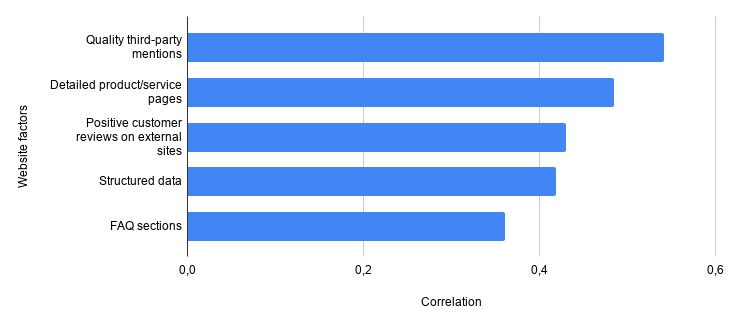
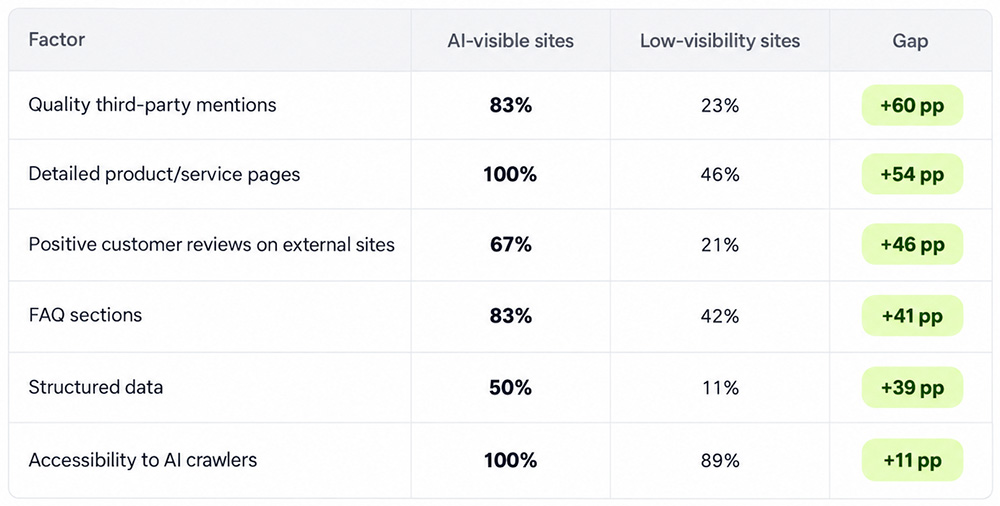
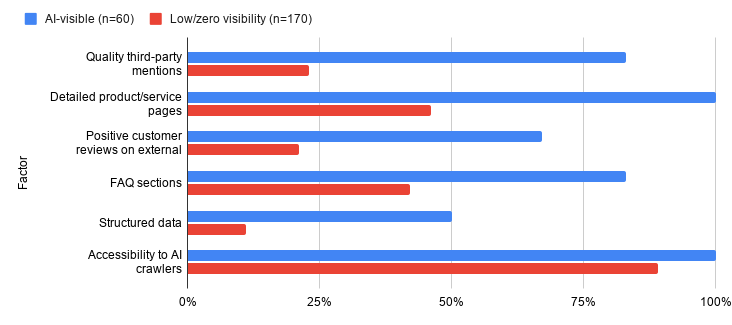
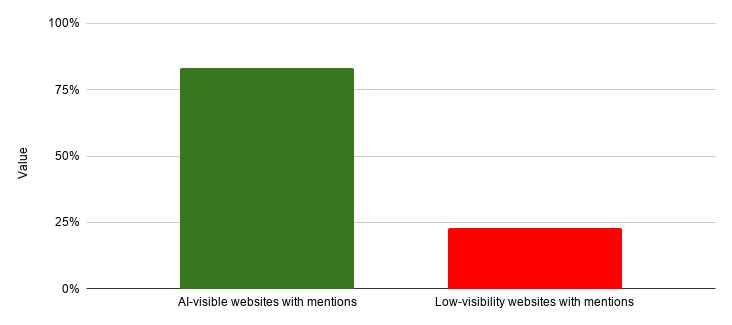
Quality third-party mentions showed the biggest correlation with AI visibility. 83% of sites with good AI visibility had them, compared with only 23% for low-visibility sites.
Detailed product/service pages had the second-strongest correlation with AI visibility (100% vs. 46%).
Websites with both strong internal pages and quality third-party mentions showed the best results in AI search. Their on-site content helped LLMs understand what their business does, while third-party mentions gave more credibility.
When websites had only one type of signal, either on-site or off-site, their chances of showing up in AI search have been lower.
No single factor can guarantee AI visibility. 50% of AI-visible websites didn’t have structured data, and 17% had no quality third-party mentions.
How we analyzed AI visibility
Timeframe: August-September 2026.
Location: UK-based websites.
Industries: Legal firms.
Scope: Data from 230 AI visibility audits. 60 of the analyzed websites (26%) had visibility in AI search with 20+ mentions. 170 sites (74%) either had no visibility at all or fewer than 20 mentions across LLMs.
Methodology: We measured websites’ AI visibility with Ahrefs. Then, we analyzed how different on-site factors (product/service pages, structured datRea, FAQs, accessibility to AI crawlers) and off-site factors (customer reviews on external sites, backlinks, and third-party brand mentions) correlate with AI visibility.
Here is how AI-visible and low-visibility sites compare:
The percentages show how many websites in each group have a particular characteristic. The gap shows the difference between the two groups in percentage points (pp).
Off-site factors
Quality third-party mentions
All websites we analyzed had some backlinks and mentions. But most of them came from spammy sites and online catalogs.
When it came to AI-visible websites, 83% had quality external mentions. This finding aligns with previous research by Ahrefs, showing a strong correlation between brand mentions and AI visibility.
We define quality mentions as relevant listicles, expert articles, interviews, product/service reviews, and so on. Listicles, in particular, are considered one of the most cited content formats in AI search by Wix. And this is the type of content we often use for our clients at Mentio.
But even though third-party mentions seem really important for AI visibility, according to several credible studies, our research found an interesting detail. 17% of AI-visible websites achieved good AI performance without quality third-party mentions.
Did those websites have anything in common? In fact, they did:
Informative, well-optimized product/service pages.
Positive customer reviews across platforms.
Team pages with information about the team’s experience.
Author pages that explained the author’s expertise.
If you’re looking into ways of getting more quality mentions online to improve your AI visibility, Mentio can help.
Positive customer reviews on external sites
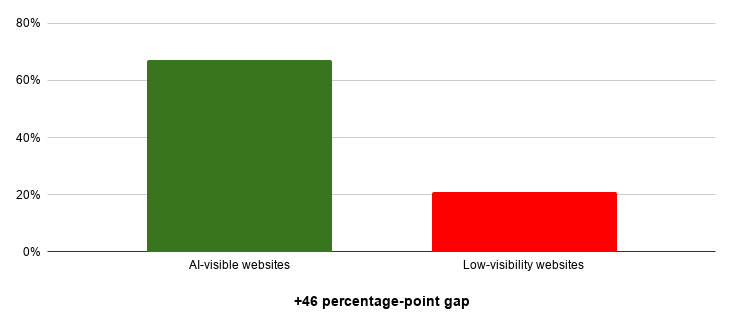
Positive client feedback published on external sites was the third most important factor that differentiated websites with good AI visibility from those with little or no visibility.
When we analyzed how customer reviews on external sites (Google Maps, Trustpilot, specialized platforms, etc.) influence performance in AI search, we saw that:
67% of AI-visible websites had positive reviews across platforms.
But the same was true for only 21% of low-visibility websites.
Note: We only considered businesses with more than 10 reviews and with ratings of 4.5 or more.
On-site factors
Detailed product/service pages
Detailed product/service pages turned out to have the second-strongest correlation with AI visibility.
What we saw, essentially, was that 100% of AI-visible websites in our study had detailed product/service pages. As for the low-visibility sites, this number was 46%.
By “detailed product/service pages,” we mean pages that:
Clearly describe what the business offers,
Define who its offer works best for,
Show what its workflow looks like,
Explain which problems it solves and how,
Include pricing and FAQs,
Provide information about its team and/or experience.
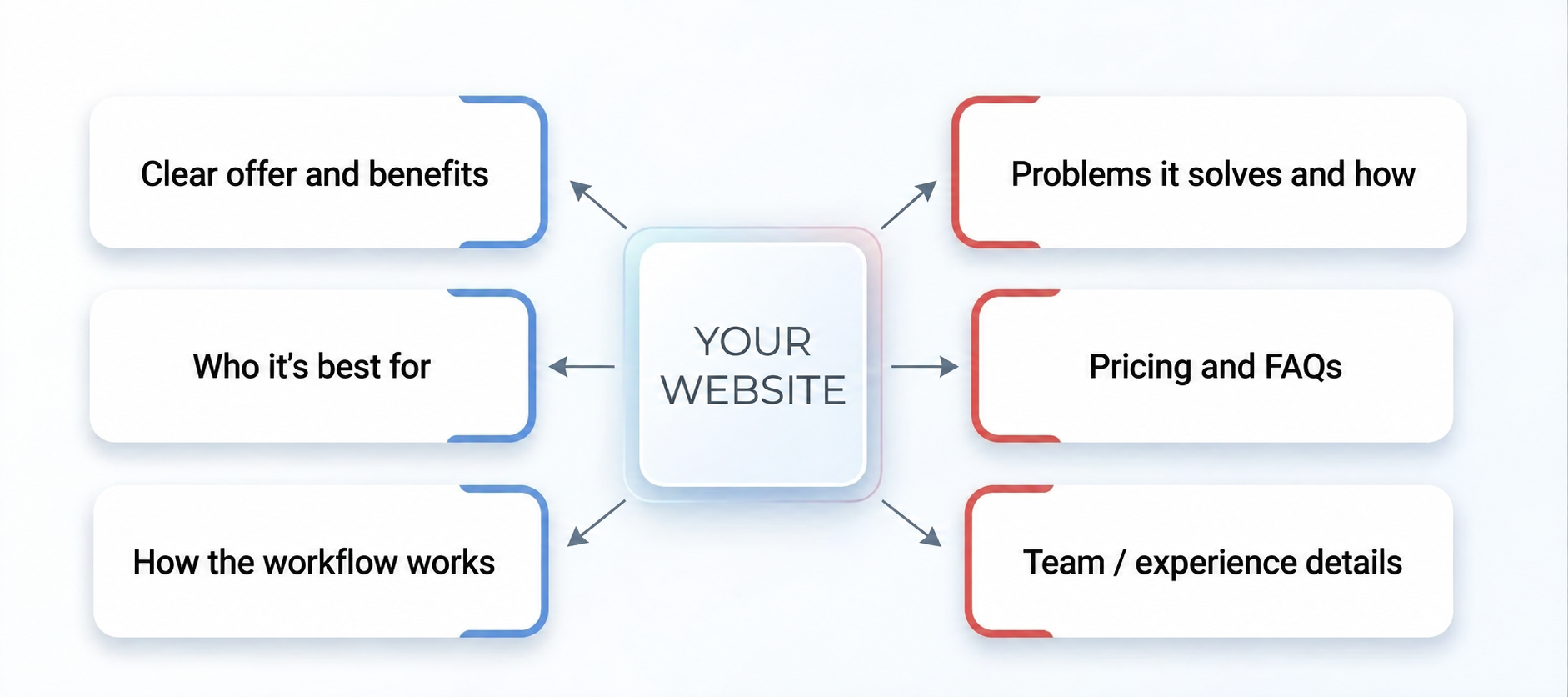
Strong, informative service/product pages seem to be the foundation of AI visibility, as they help AI systems understand your business. But they alone aren’t enough.
Based on what we see, good performance in AI search is a combination of factors, and having strong on-site content is just one of the elements.
Structured data (schema markup)
Only 50% of AI-visible websites had structured data. And while that's much higher than the 11% of low-visibility websites, it still means that 50% of sites that do well in AI search didn't have schema markup in our analysis.
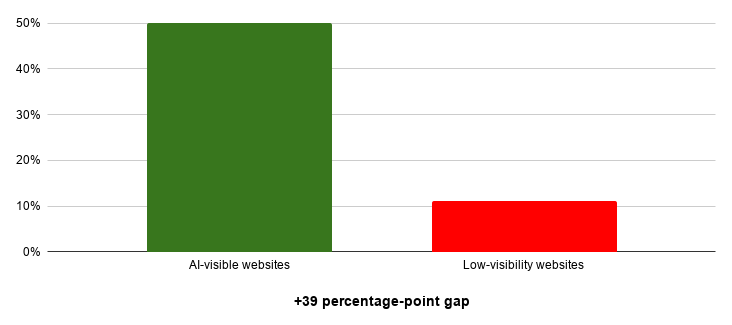
Structured data is often considered one of the important elements of AI visibility. But our data shows that half of sites that succeed in AI search don’t have schema markup at all.
This 50-50 situation almost mirrors Google’s stance on structured data for AI visibility:
Overfocusing on structured data: Structured data isn't required for generative AI search and there's no special schema.org markup you need to add. However, it's a good idea to continue using it as part of your overall SEO strategy, as it helps with being eligible for rich results on Google Search.
FAQ sections and pages
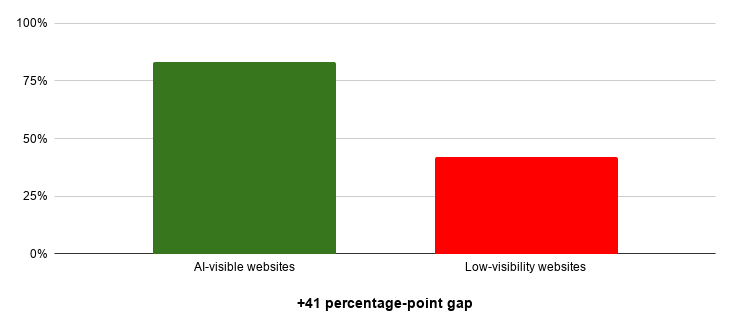
Having clear answers to frequently asked questions also showed an association with better AI visibility.
In fact, 83% of AI-visible websites had FAQs, compared with 42% of low-visibility websites.
An FAQ section is essentially another way to better explain what makes your brand special and provide all the necessary details in a digestible format.
Accessibility to AI crawlers
100% of websites with good AI visibility were accessible to AI crawlers, which was obvious.
But what was quite surprising is that 11% of sites that were interested in improving their AI visibility had robots.txt blocking AI crawlers. This means that AI bots couldn’t directly access, crawl, and extract information from those sites.
Essentially, LLMs could only recommend these businesses based on external sources. But AI systems couldn’t use their web content directly, no matter how good and unique the information on their site was.
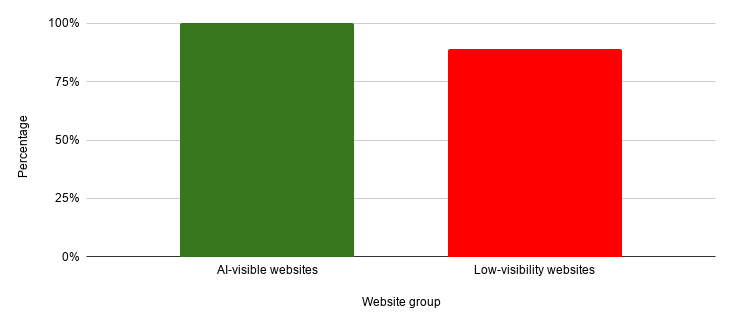
While 89% of low-visibility websites were accessible to AI crawlers, this alone wasn’t enough for those businesses to get cited by AI search engines.
How to get cited by AI search engines: What businesses can do based on research
Based on our Mentio AI Visibility Report 2026, these are some of the most effective tactics you can use to get cited by AI:
Get quality mentions and reviews: Your brand’s external validation matters. That’s why make sure you get mentions on authoritative websites in your niche, paying special attention to listicles, expert quotes, product/service reviews, and so on. Besides, get as many authentic customer reviews across platforms as you can.
Work on your product/service pages: Improve the content on your own website and make sure all your product and service pages clearly describe what your offer is all about, who it is for, how much it costs, what your workflow looks like, and so on.
Make sure your website’s technical setup is strong: Having structured data and a website that’s accessible to AI crawlers won’t automatically make you visible in AI search. But these can provide a strong foundation for other tactics to work.
Bottom line
Two major conclusions we can make after putting this research together are:
It’s important to target AI visibility from two sides. On one hand, your website has to clearly explain to AI systems what your business does and what expertise you have. And on the other hand, authoritative third-party sources have to give AI systems a reason to trust your expertise.
There is no single tactic that can make your brand visible in AI search. If you look at the numbers, all the approaches we talked about today appeared among both AI-visible and low-visibility websites. So, the solution isn’t to find one magic pill, but to combine several tactics into one comprehensive strategy.